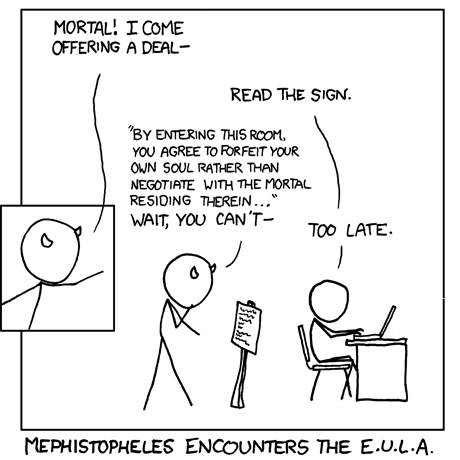
Everyone in this class has probably accepted an end user license agreement (EULAs) at least once in their life. They are those windows filled with legal text that pop up when you install new software. In order to actually use the software, you need to click an “I Agree” button. Sometimes, you don’t even need to click a button since using the software means you’ve implicitly “agreed” to whatever terms were specified. However, does anybody actually read all of the terms and conditions set forth in a EULA? Very few people have due to the length of such documents as well as the indecipherable legal language that is often used. The question you might be asking now is why should I care what is in the EULA?
To answer that question we need to look at how software is distributed and used. When you purchase software whether digitally or physically, you are purchasing a license to use that software. This means what you are buying is the right to use that software; you do not actually own the software. However, granting a license to use software requires certain terms and conditions to be outlined which is the primary intent of a EULA. This is why nearly every piece of software you install will contain a EULA. Along with software, similar legal statements are found when using services such as websites and online tools. These are known as Terms of Use which are slightly different but are just as confusing and full of legalese as their cousin the EULA.
 |
| Do you read EULAs? |
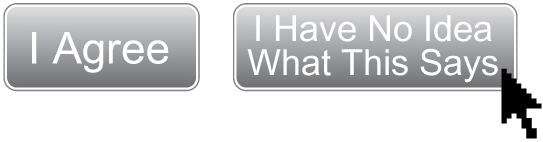
Now that we know what a EULA is, let’s take a look at some of the issues that have been cropping up over them. While the purpose of a EULA is primarily to define what a licensor can do with a copy of software, many companies have used EULAs to add additional terms and conditions that are often harmful to consumers in terms of privacy. The long legal text makes it easy to obfuscate certain terms and conditions that one would normally not agree to. In addition, while EULAs are theoretically a contract between each individual user and the manufacture of that software, in reality there is no room to negotiate the terms of the contract leaving consumers with a “take it or leave it” attitude towards software.
 |
| They mean the same thing to most people. |
Do not criticize this product
Basically, you waive your rights to criticize the product, complain about the product, or publicly disclose negative opinions about the product. Some EULAs take it urther and prohibit benchmarking the product or performing any sort of analysis that may reveal potential flaws in the software.
You give the company the right to be monitored
Many EULAs contain provisions that give the company the right to perform actions that can be considered an invasion of privacy. This can be things from snooping on what software you are running to remotely installing third party software.
You cannot reverse engineer the product
Although US copyright law allows for reverse engineering of products under a fair use clause, many EULAs prohibit reverse engineering the software.
Don't use this software with other software that may affect its performance
This clause is often included in EULAs in the context of preventing users from analyzing the software's performance or to prevent the circumvention of certain parts of the software such as advertising.
"By signing this contract, you also agree to every change in future versions of it.
Oh yes, and EULAs are subject to change without notice."
They can change the terms you "agreed" to without having to notify you. So what you agree to today may be invalid tomorrow. It might even be worse.
Now that you know what an end user license agreement is and how they work, what are your thoughts on EULAs? Do you read EULAs before agreeing to the terms? Are there things that concern you in an EULA? Feel free to comment below!
References
- https://www.eff.org/wp/dangerous-terms-users-guide-eulas
- http://caselaw.findlaw.com/us-7th-circuit/1405266.html
- http://www.yalelawjournal.org/the-yale-law-journal/content-pages/the-law-and-economics-of-reverse-engineering/
- http://papers.ssrn.com/sol3/papers.cfm?abstract_id=582402
xkcd, cc-nc license
GNOME project
EFF

No comments:
Post a Comment