Friday, June 7, 2013

Fair Use - Flexible Fair Use for Technology in Australia (Team 6)

Just recent, June 5th, the Australian Law Reform Commission (ALRC) posted a paper outlining changes to Australian copyright law that would replace the existing “copyright exceptions” section with a broader, more flexible, American-style Fair Use clause (zdnet article). Seeing as right now the number of countries with a Fair Use policy can be counted on one hand (Wikipedia Fair Use) this could be a good step forward for other nations.

The ALRC proposal includes several different categories for Fair Use to be judged on: “Research or study; criticism or review; parody or satire; reporting news; non-consumptive (such as caching); private and domestic; quotation; education; and public administration.” Under their current laws, cable providers offering the ability to watch any show streamed from the cloud to your television is technically against the copyright of the show holders. This new Fair Use policy would allow Australian law to better reflect the technological world we live in.

And if that wasn’t promising enough, the ALRC is taking in Australian citizens opinions in account before they make their final proposal to the rest of the government. Hopefully this law reform will go through and we can move towards a future with more friendly copyright systems for all nations.

Wednesday, June 5, 2013

Questionable, Ridiculous, and Just Plain Silly EULAs

Following up on my previous post describing what a EULA is and how they work, let's look at some EULAs of some more well-known pieces of software or hardware that you may be using. Some of the terms and conditions of the EULA will surprise you.

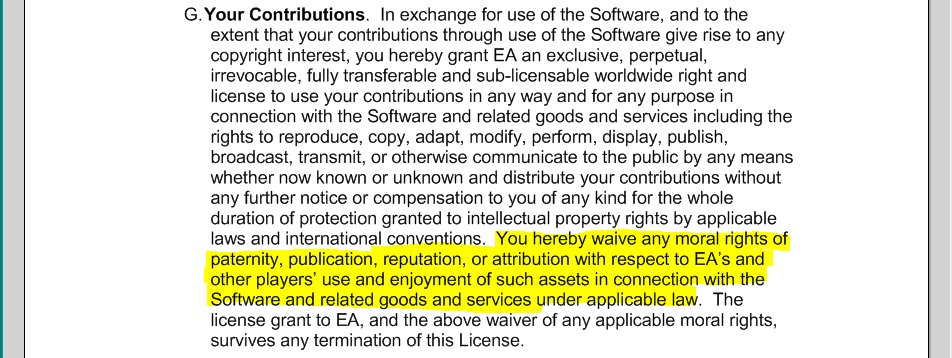
I waive my moral rights to EA
Here's another EULA from EA. Basically, EA owns whatever you create and produce on the software. You also waive your moral rights to EA. Also note both the license grant and waiver is still in effect even if you terminate the EULA.

Sony, EA, Steam – No Class Action Lawsuits
The latest revisions of the EULA for the Sony, Electronic Arts, Steam, Microsoft, and a multitude of other prominent software vendors now contain a clause that specifically prohibits the user from engaging in class action lawsuits. Below is an excerpt from the Sony EULA that users must accept to use a PlayStation console.
ANY DISPUTE RESOLUTION PROCEEDINGS, WHETHER IN ARBITRATION OR COURT, WILL BE CONDUCTED ONLY ON AN INDIVIDUAL BASIS AND NOT IN A CLASS OR REPRESENTATIVE ACTION OR AS A NAMED OR UNNAMED MEMBER IN A CLASS, CONSOLIDATED, REPRESENTATIVE OR PRIVATE ATTORNEY GENERAL LEGAL ACTION.

These clauses typically mean if you have any grievances against the company, you give up the right to a lawsuit and must go through an arbitration process that is outside of the courtroom. Unfortunately arbitration payouts are usually much smaller and the playing field is unbalanced towards large companies who have well compensated lawyers.

What do you mean I can't use iTunes to create nuclear weapons?
The iTunes EULA below pretty much explains itself. Guess my evil plan to take over the world has been thwarted.

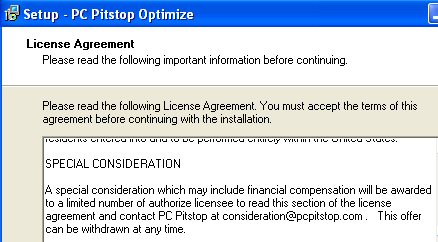
Read the EULA, get a prize
Since everyone knows that people don’t read EULAs, one software manufacturer actually included a statement within the EULA that stated that a “Special consideration which may include financial compensation” will be given to users who read the EULA. Someone did eventually claim the $1000 prize, four months later.

Perhaps one way to get people to read EULAs would be to include prizes for reading through the document. Unfortunately, most manufacturers don’t want you to read through EULA since that would mean they would be unable to hide controversial clauses in them.

Read a 57 page EULA to watch Sleeping Beauty
Even kids aren't exempt from reading EULAs. The image below is of a 57 page EULA that appears when you insert the disc for Sleeping Beauty. This is an interesting case since movies traditionally did not have EULAs. However with any Blu Ray discs now containing interactive content and downloadable content, EULAs are cropping up. In this case, the EULA appeared since the disc was trying to update content which meant having to accept the EULA.


After reading through these examples, do you now feel the urge to read through EULAs before clicking Accept? Feel free to comment below if you have any additional examples of EULAs like the ones I posted.


Here is the URL to the blog that I started on Blogger regarding Gender issues in Computer Science
http://www.blogger.com/blogger.g?blogID=3279597936089152609#allposts/src=dashboard

Tuesday, June 4, 2013

Team 11, Post 4, Hacktivism: Anonymous for Victims of Assault and Bullying


Team 11, Post 4, Hacktivism: Anonymous for Victims of Assault and Bullying


Introduction

Recently there have been several instances of the hacktivist group Anonymous focusing their attention on cases involving victims of sexual assault and bullying. Two of the three cases discussed in this post resulted in the victim committing suicide. The first case involves a teenage girl named Amanda Todd, who was victimized by a pedophile, resulting in incessant bullying by classmates and lead to her suicide. The second case concerns Rehtaeh Parsons, a teenage girl was allegedly gang-raped by four boys at a party, also resulting in bullying from her classmates and ended in her suicide. Finally, the third case is of a 16-year-old girl from Ohio, who was drugged and raped by two boys, Trent Mays and Ma'Lik Richmond, in public resulting in videotape and photographs of the repeated assaults.

What does this have to do with hacktivism? At first glance, not much; however, it turns out these cases sparked the interest of Anonymous. The group took it upon themselves to, in some cases, locate the parties responsible for the events that took place and expose evidence to the authorities for justice to be served.

Amanda Todd

Amanda's nightmare began when she was 12-years-old, vulnerable and naïve to an older man online. He convinced her to flash him and then about a year later, tried to blackmail her with the picture he took with his webcam. The man threatened if she did not put on a show for him he would send the picture he took of her to all her friends. She refused him and called his bluff, but he was not bluffing. This led to many years of torment from her classmates, who began calling her a porn star and voted her homecoming queen as a joke. Amanda was the butt of every joke and to this 15-year-old girl, it was the end of the world. Amanda posted a video before she took her life, in an effort to tell her story. (Szalavitz)

Anonymous posted a video in response to this tragic event, claiming they had identified the man who was blackmailing Amanda Todd. Anonymous revealed the name and address of the man on Pastebin.com (Sieczkowski). Apparently, Anonymous did not choose to get involved until nude autopsy photos were leaked online (Sieczkowski). The group sent and email to a Canada's CTV News, stating, “We generally don’t like to deal with police first hand but were compelled to put our skills to good use protecting kids. (Sieczkowski)”

Rehtaeh Parsons: #OpJustice4Rehtaeh

Rehtaeh Parsons a 17-year-old girl from Nova Scotia committed suicide on April 7, 2013. Rehtaeh had been mercilessly bullied by school mates following her allegedly being raped by 4 boys at a party. One of the assailants took a picture during the rape and passed it around their school. The photo went viral on social media sites and resulted in her being harrassed, receiving text messages from peers asking her to have sex with them too and calling her names (Harkinson).

The assault transpired 2 years prior to her suicide and resulted in her going from a straight A student to a high school drop out, due to depression and anxiety (Harkinson). Rehtaeh's case for the assault was dropped by authorities due to a lack of evidence.

Following Rehtaeh's suicide, Anonymous stepped in to do some digging of their own. They claimed to have identified the rapists in 2 hours, using the photo that was taken during the assault (Harkinson). Anonymous threatened to release the names to the public if the police department did not reopen the case and get Rehtaeh's family justice, claiming that if they could uncover this much information in a couple of hours, surely they could find more if they tried (Harkinson). However, Rehtaeh's family asked Anonymous not to release their names, worrying for their safety, stating their daughter would not want that (CBC). Anonymous agreed to respect their wishes but warned that others were interested in justice too, and may not keep the boys identities secret.

The Friday following her death and two days after the video announcing their demands for the reopening of Rehtaeh's case, the police department did just that. The PD claims that the reopening had nothing to do with the information obtained from Anonymous (Bogart). Maybe the evidence did not come from Anonymous that sparked the investigation, but it is a fair assessment that their interest and public outcry for justice got things moving again.

Steubenville, OH Rape Case #OpRollRedRoll

Two members of the Steubenville High School football team, found a extremely intoxicated 15-year-old girl at a party and decided to carry her around from party to party, urinating on her and raping her repeatedly. Many people in the community witnessed this happening to the incoherent girl and instead of reporting it to authorities or stopping the guys, some joined in, taking pictures and laughing and others just did not say anything at all. The following day news spread throughout the small town of Steubenville swiftly. The two main assailants involved were charged with the rape, but Anonymous stepped in because they felt like the town was not taking the crime seriously enough and the authorities were corrupt (Marcotte).

Anonymous involving themselves in this case resulted in national media attention. Everyone heard about the rape of a girl by members of the football team in the sleepy town of Ohio. Without Anonymous, would the case have received the same attention? Probably not. Once Anonymous took this on as something they wanted justice for, things moved pretty quickly. The group hacked into the “rollredroll.com,” the high schools athletics page, posting incriminating tweets and information regarding individuals they believed were assisting in covering up details of this crime. According to Amanda Marcotte's article in Slate Magazine, “Anonymous has been vital in getting out at least some of the evidence of the assault to the media.”

In March, the group posted a video, called ExpectPeace, commending the Sheriff of Steubenville. They initially were not a fan of him, but said that he spoke with them during the demonstrations and protests they conducted in the town and offered them his full support in the cause.

Conclusion

These particular cases are not typical, until recently, of Anonymous, but are definitely in the same realm of their corporate hacktivism operations. The group proclaims they are committed to justice being served and when corrupt agencies attempt to cover up details or take advantage of the 99-percent, they will be there, ready to expose the truth. Anonymous taking interest in this type of crime against humanity, the issues of rape and cyberbullying, has the potential to help stop these things from happening. Unfortunately, the approach is not the best, and has skirted the lines of a violation of privacy for some people that happen to fall under the umbrella of direct or inadvertant involvement in these crimes. Anonymous, also, falsely accused a man for cyber-stalking and blackmailing Amanda Todd. The man was already detained at the time for sexual assault of another minor, so they did not feel to bad about that mistake.

Many call them vigilante's, they do not agree with that label. A representative of the group said, “We do not approve of vigilante justice as the media claims. That would mean we approve of violent actions against these rapists at the hands of an unruly mob. What we want is justice. And That's your job. So do it." (Caufield)


Works Cited

Caulfield, Philip. "Group claiming to be Anonymous threatens to unmask boys accused of raping Canadian girl who died after suicide attempt   - NY Daily News." Daily News America - Breaking national news, video, and photos - Homepage - NY Daily News. N.p., 11 Apr. 2013. Web. 5 June 2013. <http://www.nydailynews.com/news/world/anonymous-threatens-unmask- boys-accused-raping-canadian-girl-article-1.1313547#ixzz2VJnBrHcm>.

CBC News. "'Anonymous' won't release names of Rehtaeh Parsons suspects - Nova Scotia - CBC News." CBC.ca - Canadian News Sports Entertainment Kids Docs Radio TV. N.p., 12 Apr. 2013. Web. 5 June 2013.

Harkinson, Josh. "Exclusive: Meet the Woman Who Kicked Off Anonymous' Anti-Rape Operations | Mother Jones." Mother Jones | Smart, Fearless Journalism. N.p., 13 May 2013. Web. 4 June 2013.

Marcotte, Amanda. "Steubenville, Ohio rape: Anonymous gets involved, and the case gets even more complicated.." Politics, Business, Technology, and the Arts - Slate Magazine. N.p., 3 Jan. 2013. Web. 5 June 2013. <http://www.slate.com/blogs/xx_factor/2013/01/03/steubenville_ohio_rape_anonymous_gets_involved_and_the_case_gets_even_more.html>

Red, Christian, and Teri Thompson. "Steubenville rape case: Victim hopes one day to forgive Trent Mays & Ma’Lik Richmond, who were found guilty in rape of 16-year-old by Ohio judge." NYDailyNews.com/U.S. N.p., 17 Mar. 2013. Web. 3 June 2012. <https://www.nydailynews.com/news/national/steubenville-high-school-football-players-found-guilty-rape-16-year-old-judge-article-1.1291087>.

Sieczkowski, Cavan. "Amanda Todd's Alleged Bully Named By Anonymous After Teen's Tragic Suicide." Breaking News and Opinion on The Huffington Post. N.p., 16 Oct. 2012. Web. 4 June 2013.

Szalavitz, Maia. "Amanda Todd's Suicide: Internet and Psychological Toll of Bullying | TIME.com." Health & Family | A healthy balance of the mind, body and spirit | TIME.com. N.p., 16 Oct. 2012. Web. 4 June 2013.

The Future of Offshoring from the U.S. Consumer Standpoint


            Over the course of the quarter we have seen U.S. companies offshore to other countries, other countries offshore to the U.S., as well as strategies states used to attract foreign investment. Phew, so much information! Now it is time to put everything together in terms of where offshoring is headed for the future. A little clue given earlier was that offshoring is no longer restricted to the U.S. approaching developing nations. Some countries are approaching America because companies are beginning to search beyond just costs (Ellis). While costs are crucial to a business remaining lucrative, there are other very important incentives that will automatically cover the cost portion such as global exposure in order to gain investors.
        Another important future trend I see is the popularity of producing within the United States. In addition to avoiding the negative stigma offshoring carries, producing internally is popularizing. While it is more expensive to produce in America, costs are lowering and a greater number of people are willing to pay more knowing that the good was made in the U.S. Additionally, I notice a growing trend in goods being more wholesome. What I mean is that consumers are looking for humane companies that do not test on animals for example, or choose to find more natural foods whose ingredients are easily recognizable, as well as making sure that goods are benefitting the U.S. people, which generally occurs from buying goods manufactured internally.
        I very well could be wrong about all these predictions, but when I observe people’s daily habits in conjunction with the negativity that offshoring receives, it is plausible.
        Offshoring has also had a delayed effect on consumers as whole, but the trends did not catch on until much later when people were expecting their goods to remain intact or functional.  Quality assurance has for the most part been the first thing to go for the sake of cost. Let me ask you, is it worth purchasing 10 cheap shirts that have all ripped apart or 2 more expensive shirts that have remained in tact for over five years? These are the kinds of questions consumers are asking! Having had numerous complaints, refunds, and poor reviews, companies are looking to bring their brand back home due to insufficient quality An example of such a move is Sleek Audio, a provider of high end headphones. This company worked with China for quite some time for the sake of reducing costs. Unfortunately there were so many quality issues that the CEO and his son had to make numerous trips just to alleviate these problems (Koerner 2011). They ended up spending more while on striving to save money. It completely defeats itself!
        I understand that this is just one example and there are probably more companies offshoring than not, however according to a survey distributed between 2010 and 2011 by MFG.com, 19% of participating businesses disclosed that they moved some or all of their company back home (Koerner 2011).
        Lastly, since China is an offshoring hotspot, we are seeing rising trends in China’s wages gradually. Wages are still drastically cheaper than wages in the states, however the numbers are steadily growing, so the justification of cheaper labor may not hold up in a few years.
        In sum, offshoring has its ups and downs, but at the end of the day, it lies in the hands of the consumers. While businessmen can cut costs and produce cheaper, if they hold up, consumers will keep buying that company’s goods. If quality suffers as a result of offshoring, consumers’ willingness to buy decreases. I cannot fully say one party wins or loses, but what I can assure is that there are some serious changes happening in the living standard of the American people, so keep your eyes out for what happens in regards to offshoring!

Works Cited

Monday, June 3, 2013

Reporting Live...Anonymous may have a news site soon!


This just in, Anonymous wants to bring you the latest breaking news! Apparently, Anonymous wants to host a web site in more of a formal reporting-the-news form. They have been working towards this for the past couple of months. The amount of support is pretty impressive and having a news site to report out of would be great. I am however, wondering how long they’ll be able to keep it up before the government starts breathing down their neck, especially if they release stories in which the government considers to be “private” or “sensitive” information. Regardless many people have vocally and monetarily support this idea. Anonymous “raised $54,000 for the purpose of launching a site that would take the group’s nascent newsgathering efforts beyond Twitter and Tumblr” (Gillette).
What’s unknown is why Anonymous doesn’t use or rely on Facebook to gather information or spread their message. “Among other things, the site will aggregate news from various indie news sources. It will also integrate information from Twitter while largely shunning Facebook (FB)” (Gillette). Perhaps Anonymous feels as if Facebook is unreliable. For whatever reason, Anonymous states that they will accumulate data from multiple sources, clearly one of which will not be Facebook, and substantiate these into one steady stream, their news site.
What I like most about the idea of this site is that it will be informative and educational, without various users chiming in and arguing via the comment section. Your Anon News officially stated “there will be no comments section” (Gillette). People will be able to submit stories while the web site will filter out these submissions based on “quality, authenticity, and relevance” (Gillette). I like this because it still gives the common user a place to contribute and be a part of the online Anonymous community while restricting any potential rants and ravings via the comments section.
I’d like to digress for a quick second and give my opinion on the use of a comments section and why I whole-heartedly applaud Anonymous for not putting them into their news site. I often find a lot of the times, that news stories on different websites are interesting and legitimate, only to read the ignorant and obnoxious comments by users. In my mind, I know the hosts of these sites aren’t responsible for these comments, but it still ruins the content of the main articles. On the other hand, and not to completely contradict myself, I understand the comments section gives people access to discuss, ask questions, elaborate, and so on but more often than not the comments don’t add any content to the articles and usually end with some kind of argument which may or may not even be related to the original story in the first place.
Overall, I think the idea of the website sounds wonderful. The goal is to actually report real news that has more of a global and ethical impact. Anonymous wants to report stories such as “Why isn’t CNN-Turk airing footage of [] massive protests” instead of stories about “Kardashian[‘s] [exploding] butt implants” (Gillette). This is a breath of fresh air of real journalism that has more or less begun to elude mainstream in light of more popular, but not necessarily more informational, stories. I can’t wait until Anonymous’ news site is up and running.


Works Cited:

Gillette, Felix. "Anonymous Prepares to Enter the News Business." BusinessWeek, 3 June 2013. Web. 3 June 2013. <http://www.businessweek.com/articles/2013-06-03/anonymous-prepares-to-enter-the-news-business#r=rss>.

Saturday, June 1, 2013

Summary of Work: Open Source and Net Neutrality

My last post was the finale of my opinions on my research - but I wanted to give a summary of all the research I have done and give links too all the blogs that I wrote.

Top sources relating to public policy for Net Neutrality:
http://www.cbc.ca/news/canada/story/2005/07/24/telus-sites050724.html
This article was an example of why Net Neutrality needs to be addressed by the people. The company TELUS cut access to a pro union website. This is an example of a lack of Net Neutrality, and the company TELUS trying to have more control than, in my opinion, they should.

http://money.cnn.com/2010/11/30/technology/netflix_level3_comcast_traffic/index.htm
This article was an example of why Net Neutrality needs to be addressed from a business standpoint. Since the company who was providing services for Netflix was using lots of bandwidth, Comcast wants to charge them extra.

http://www.theverge.com/2012/9/18/3351626/att-facetime-block-fcc-complaint-net-neutrality
AT&T was not allow users to use face time if they did not pay for minutes. (essentially a business descision because they didn't want users to just use data plans, they wanted them to pay for minutes/texting and data).

Top sources relating to public policy for Open Source:
http://www.fsf.org/
As a whole, the Free Software Foundation is a good source for understanding some of the public policy surrounding Open Source. It was one of the first places me and my team looked to.

http://opensource.org/
Another broad example, the Open Source Initiative is a good source of getting your feet wet with the public polices in open source.

http://www.whitehouse.gov/omb/Circulars_a130_a130trans4
A direct example of a public policy relating to Open Source. This are far and few between when it comes to the US, but they are more popular in the EU. But as a research group, we were focused primarily on the US. The bill was against Acumulo, which was talked about in our presentation, it essentially bars the Department of Defense from using accumulo-commitees'

List of my blogs:
Open Source:
http://css411uwb.blogspot.com/2013/05/open-source.html
http://css411uwb.blogspot.com/2013/05/open-source_18.html
Net Neutrality:
http://css411uwb.blogspot.com/2013/05/open-source.html
http://css411uwb.blogspot.com/2013/05/deep-packet-inspection_9.html
http://css411uwb.blogspot.com/2013/05/public-policy-in-open-source-and-net.html

These were my main inspirations for my blogs - even though the majority of my blog was focused on strictly my opinion of the policies and some of the issues relating to Open Source and Net Neutrality.

Cheers,
Brandon